Monument Valley
National Monument - Arizona, Utah
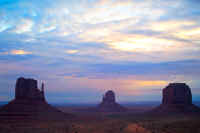 Monument Valley
is a scenic region encompassing approximately 5,180 sq km
(2,000 sq mi) in northeastern Arizona and southeastern Utah.
The landscape is characterized by tall, red sandstone buttes,
mesas, and arches created by erosion, rising up to 300 m
(1,000 ft) from a sandy plain. Monument Valley is part of the
Navajo Indian Reservation; the Navajos have occupied the
valley since the 1860s. Rainbow Bridge and Natural Bridges
national monuments are nearby. Monument Valley
is a scenic region encompassing approximately 5,180 sq km
(2,000 sq mi) in northeastern Arizona and southeastern Utah.
The landscape is characterized by tall, red sandstone buttes,
mesas, and arches created by erosion, rising up to 300 m
(1,000 ft) from a sandy plain. Monument Valley is part of the
Navajo Indian Reservation; the Navajos have occupied the
valley since the 1860s. Rainbow Bridge and Natural Bridges
national monuments are nearby.
Tall, red sandstone
buttes and mesas rise up from the sandy plain of Monument
Valley in northeastern Arizona and southeastern Utah. The
scene of countless western movies, the valley has come to
symbolize the open spaces and rugged landscape of the American
West.
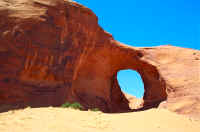 Monument Valley is part
of the Colorado Plateau. During the Eocene epoch of the
Cenozoic era, huge quantities of these rocky mountain
sediments were deposited in the section of land that now
contains Monument Valley. At the same time, a regional uplift
occurred on the Colorado Plateau. The plateau was pushed
upward by pressure from below. It broke and cracked, thus
creating a new cycle of erosion. Most of the breaking was done
underground long before the rocks were revealed. Monument Valley is part
of the Colorado Plateau. During the Eocene epoch of the
Cenozoic era, huge quantities of these rocky mountain
sediments were deposited in the section of land that now
contains Monument Valley. At the same time, a regional uplift
occurred on the Colorado Plateau. The plateau was pushed
upward by pressure from below. It broke and cracked, thus
creating a new cycle of erosion. Most of the breaking was done
underground long before the rocks were revealed.
The base of the rock is made
up of what's called "Organ Rock Shale". This is the
soft rock shale. The middle section is made up of "DeChelly
Sandstone". This is the hard rock shale. At the top of the
rock is called "Shinarump". The Shinarump is made up of
mountain sediments that were deposited during the Cenozoic
era. The rocks that you see out there have what are called
joints. Joints are vertical, very smooth and even, it
determines how a 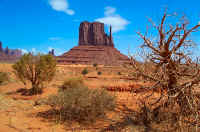 rock erodes. If you look at the
base of the rock, you will notice a slight change of color,
that part was eroded away. It was part of the
"DeChelly" formation. rock erodes. If you look at the
base of the rock, you will notice a slight change of color,
that part was eroded away. It was part of the
"DeChelly" formation.
A mesa does not start out as
a mesa, it begins to emerge when a succession of hard and soft
layers is cut into by a river or brought up by a fault. The
mesa becomes a butte, then becomes a spire, and then it
disappears.
Monument Valley's rock
formations are noteworthy mainly because they resemble animals
or other familiar images (e.g., Bear, Rabbit, Stagecoach) and
need no further explanation.
1)Mitchell Butte
and Merric Butte were named after two soldiers serving
under Kit Carson. They were killed for attempting to mine for
silver in the sacred area.
2) The Right Mitten
is the site of some dramatic automobile commercials- On
Top!
3)The Three Sisters resemble three
catholic nuns dressed in habits.
4) John Ford's
Point is named for the first Hollywood film director to
use the Monument Valley location for a film set. That first
film was Stagecoach, starring John Wayne. Since
then, many major films and TV episodes have been shot using
Monument Valley sites. This particular site also is often used
in automobile commercials. Following are some of the better
 known films shot in the
Valley: known films shot in the
Valley:
Kit Carson-1940
Billy the Kid-1941
My
Darling Clementine-1946
Fort Apache-1948
She Wore a
Yellow Ribbon-1949
The Searchers-1956
How the West Was
Won-1962
Mackenna's Gold-1969
The Trial of Billy
Jack-1974
The Eiger Sanction-1975
The Legend of the Lone
Ranger-1981
Back to the Future II and
III-1983/91
Forrest Gump-1993
Tall
Tales-1993
Lightning Jack-1994
Waiting to
Exhale-1995
5) Rain God Mesa was a platform for
"medicine men" to pray for rain and contains a sacred burial
ground.
6) The Hub not only looks like the
center of a wagon wheel, it also is the geographic center of
Monument Valley.
7) Thunderbird Mesa is named
for the mythical creature whose form has been etched into the
side of the rock by the forces of nature.
8) The
Totem Pole is a 400 feet high scarlet rock formation
that appears to be a replica of a totem pole, pillars of wood
carved and painted representing mythical incidents among
tribes of the Northwest.
9) The Yei-Bi-Chei
resembles a holy figure among the Navajo people. In fact,
distinguished Navajo men dress as Yei-Bi-Cheis and dance for
healing purposes in a very sacred nine day ceremony called the
"Night Way Ceremony". the Yei-Bi-Chei rock formation appears
to have a line formation of several different Yei-Bi-Chei
dancers.
10) Cly Butte is named in honor of a
Navajo chieftain who is buried there with all of his worldly
possessions- cattle, goats, sheep, as well as his horse,
saddle and bride.
11) Agathlan is the core of an
ancient volcano. It was renamed "El Capitan" by Kit Carson, a
well-know soldier in the U.S. Cavalry of the
1800's.
|


